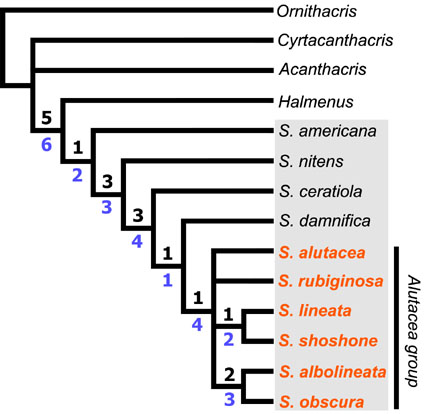
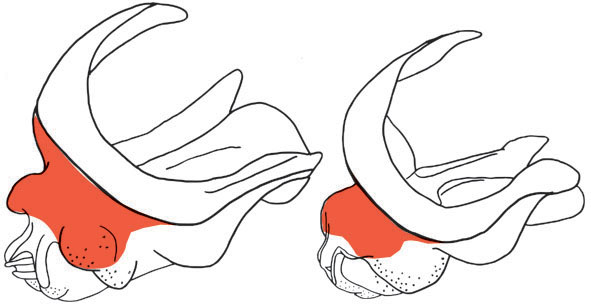
The Alutacea Group.  The Alutacea Group consists of six closely related species: S. alutacea (Harris), S. rubiginosa (Harris), S. lineata Scudder, S. shoshone (Thomas), S. albolineata (Thomas), and S. obscura (Fabricius).  It is characterized by four synapomorphies.  It is characterized by round apex of male subgenital plate, rectangular male cerci, presence of small granules on pronotum and thorax, and constricted basal eminence of zygoma in male phallic complex.  Useful plesiomorphic characters include unusually long antennae especially in males, robust body form, tegmina just slightly longer than the tip of abdomen, and tegmina colored in olive green or brown. 


This is the strict consensus of two most parsimonious trees from the cladistic analysis based on 22 morphological characters (40 steps; Ci=80; Ri=87).  Black number above the node is Bremer support value, and blue number below is the number of synapormophies for that node.


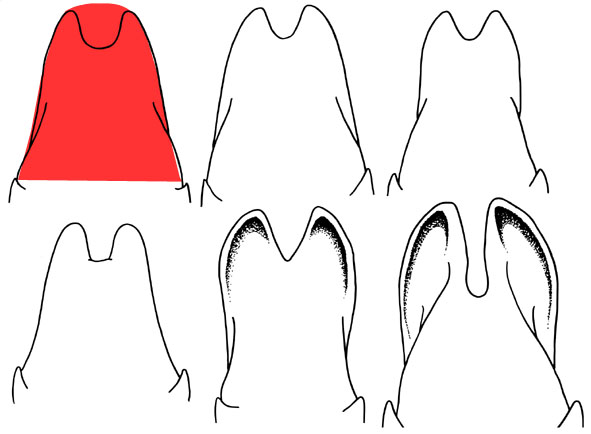
Synapomorphy 1. Round apex of male subgenital plate.  Although there are differences among different species, overall shape is always round.
Synapomorphy 2. Rectangular male cerci.  Although variation exists, overall shape is always rectangular.
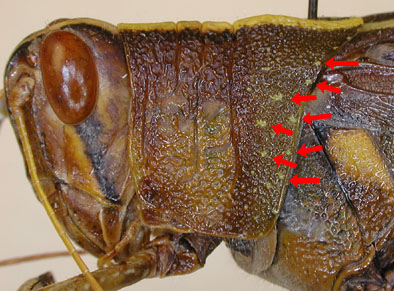
Synapomorphy 3. Presence of small granules on pronotum and thorax.  Sometimes subtle, but the species in the Alutacea Group always have this character.
Synapomorphy 4. Constricted basal eminence of zygoma in male phallic complex. Sometime prominent and other times subtle, but the species in the Alutacea Group always have this character.